About Me
- MARI
- When we do the best we can, we never know what miracle is wrought in our life, or in the life of another. -- Helen Keller (1880-1968) American Writer
Tuesday, January 4, 2011
stimr.com: Playing with Severely Impaired Special Needs Kids ...
stimr.com: Playing with Severely Impaired Special Needs Kids ...: "As professionals working with children that have severe disabilities we have found that there are ways to play with common toys and connect ..."


Sunday, January 2, 2011
More on reading!!!
Since language is very difficult to acquire for a child with severe disabilities, reading is extremely important. I read to my children as infants, toddlers, young preschoolers, elementary aged and up to age 10. This not only encouraged them to read, but created a rich living vocabulary and imagination that allowed them to express themselves and more ably explore their universe.
We don't know the mental capabilities of these children with severe disabilities. We do know that sensory and intellectual stimulation on a daily basis is vital for the development of any child.
A fun way to incorporate language learning into book reading is to incorporate objects, puppets, switch operated toys, smells, and motions. You can then create a kit that will enrich the reading experience as well encourage language development.
Remember, books are always available at your local library for free. All you have to do is provide proof of residency. Extremely low cost books are available at books sales, yard sales and thrift shops. In this category you have to be patient and it is the "luck of the draw".
An idea for activities and kits:
The Mitten by Alvin Tresselt
A well written book that I like to read during the winter time to add to my winter themes. It is based on an old folk tale, involves themes and concepts of winter time dressing, sharing, winter animals and smaller/ bigger, inside/outside, warm/cold. The book uses repetitious language and the pictures are simple with clear outlines. There is another book out based on this folk tale by Jan Brett with beautiful illustrations, but the illustrations are too cluttered for children with possible visual limitations.
Materials:
In order to illustrate some of the concepts used in this book:
*I would have on hand oversized winter cap, boots, mittens... Two mittens in the same color that are child - sized; and one that is adult sized.
*Small stuffed animals or miniature plastic toys that are similar to the animals in the story
*for children with visual impairments, recorded sounds from the animals in the story as well as tactile samples of furs similar to the fur of the animals in the story; this would also work for children who are visually/auditorially impaired
*Optional - a pan of snow or ice cubes
How to do it:
You act the story :
Talk about cold and the weather outside. Allow the children to interact with the snow or ice cubes; at least allow the cold to briefly touch a child. Vocabulary: Winter, cold, ice, snow, BRRR
Talk about what we wear in the winter: vocabulary: hat, mittens, boots, coat scarf
When you introduce the word, allow the child to feel the object, play with it. Place the object on the child so they know what you do with it. Help them feel where it is.
When you read the story, use the objects to enhance the reading of the story. Start the story with all of the children wearing two mittens, when the child loses a mitten, have the children "lose" one of their mittens.
Continue reading the story to the end, using the miniature animals, allowing the children to feel before placing them in the mitten. Children can help to place the animals in the mitten. Have them feel the mitten get bigger and bigger. At the end of the story, pop a balloon and have the animals fly all over the place.
You can add to the story by reading extra stories about the different animals, introducing them one by one, having the children touch good quality representations of the animals, as well as fur types from the different types of animals. Online videos are excellent for this.
For further language development, add one or two step push button talkers that allow the children to "read" the repetitious parts of the story.
Use your imagination, have fun. You can even write your own version of this story using your child's name and the animals they wish to use. You can do this online or with paper and pencil and crayons or cutout pics from magazines or the internet.
Saturday, December 18, 2010
Products | Lap Tray Bag

I found this product on a search for more activities and procedures for our children. It looks like the perfect substitute for the typical laptray for either stroller or wheelchair and much more useful. See what you think.
Tuesday, December 14, 2010
Why read to severely disabled children? And which books will you read?
Speaking of Christmas gifts, books are always a good idea. You can get books with audio tapes, you can get books with textures. I try to read simple books to my 3-6 year olds, but I also read books that are age appropriate. In other words, for all my children I would select a simple cardboard preschool book that contains simple clear drawings with very little clutter. The books located in this blog are good examples of simple books with few words and very little visual clutter. The visual simplicity is extremely important for children with low vision or children with corticol visual impairment. Authors and books not pictured here are Bill Martin Jr, BABY BEN GETS DRESSED (Baby Ben Book) ,BABY BEN'S BUSY BOOK (Baby Ben Book)
 ,Pat the Bunny (Touch and Feel Book)
 Pat the Puppy (Pat the Bunny) (Touch-and-Feel)


These are just a few suggestions among many that are available to you as a person involved in the child's life. The simplicity of the books adds to the child's vocabulary, cognitive functioning. There words in the books are rhythmic and repetitive.
Even if you are not sure that a child understands/hears/sees what you are doing with the book, you are still stimulating the child with your closeness, the warmth of your body, the rhythm of your breathing and the cadence of your voice. At best you are stimulating language, visual centers and having fun all at one time.
,BABY BEN'S BUSY BOOK (Baby Ben Book),Pat the Bunny (Touch and Feel Book)Pat the Puppy (Pat the Bunny) (Touch-and-Feel)These are just a few suggestions among many that are available to you as a person involved in the child's life. The simplicity of the books adds to the child's vocabulary, cognitive functioning. There words in the books are rhythmic and repetitive.
Even if you are not sure that a child understands/hears/sees what you are doing with the book, you are still stimulating the child with your closeness, the warmth of your body, the rhythm of your breathing and the cadence of your voice. At best you are stimulating language, visual centers and having fun all at one time.
Sunday, December 12, 2010
Christmas is coming: Gift Ideas for children with severe multiple disability
Wow! Christmas is almost here. I am sure you are looking for things to buy or make for your special needs child. Here are some ideas.
1. A Fleece Wheelchair cape Directions http://www.ehow.com/videos-on_5220_sew-fleece-ponchos.html You can adapt this by making sure you have enought material for the back and front of the chair, making sure not to allow it to get caught up in the wheels. This is a no-sew project and if you are clever you can add a hood with leftover material. Many students in our school have one and they are snug and cozy inside and out.
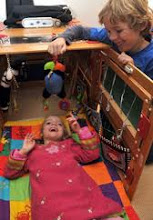
2. Make a mobile that your child can activate while sitting in a wheelchair, feeding chair or laying on the floor. The best one I've made so far involves taking a small child's mobile frame (like the fischer-price one for children up to 3-4 months), removing the toys and then hanging chimes from the frame. You can buy the frames at a thrift shop or garage sale for as little as $1.00. The amount you pay for the chimes is up to you: make sure there are no sharp edges, that the chimes are attached securely (try fishing line) and there are no small parts to swallow. Do not positiion the chimes so that will scrape a child's face, get in his/her eyes or can choke them. Off to the side to encourage swiping is great. Putting the frame above the head of a supine child encourages reaching overhead. Make sure you play a game with your child before leaving them alone with the chimes. Don't move their hands or arms. Move the chimes so that get the sound and talk about what you are doing. Play. Let the child try. Don't comment on success or not success, just play and see the movements that happen as your child makes his or her own discoveries.
You are trying for independence. While you are buying be selective, play and think. Fischer-Price, Baby Einstein, Playskool, Little Tykes, etc. all have good and interesting products to look at. Not all are appropriate for your child despite the developmental levels stated on the package. Remember, sometimes the first activations of the toys will be accidental....that is the beginning of cause and effect play. Use of VELCRO on a wheelchair tray or feeding tray and then on the toy will make sure the toy doesn't move so your child can find it again.
Many of these toys can be bought second hand at garage sales or thrift stores.
Toys for children with severe disabilities: Adults and children as Toys
That's what I meant: Adults as toys. If a child with severe impairments is used to having adults and children interacting with them, it is natural that we become part of their playscape.
Think of an infant..their first play experiences are their caretakers. Eyes meet eyes, hands gently encourage movement and touch of tiny hands, mouths smile at other mouths, sounds are echoed. All of this in play and love.
Children with severe mulitple impairments need encouragement and direct teaching to learn skills that children without impairments (or with limited impairments) pick up from their environment. Think of all the skills and knowledge that children pick up visually. Take away that vision, put a child in a soft environment like a crib with soft blankets, soft clothing, etc. and the child is put into a sensory deprivation chamber. There is little to explore, exploration = learning, so the child becomes more impaired than he or she should be with the one disability alone. When you add other disabilities to either loss of sight or loss of hearing or movement, you are not just adding disabilities, you are compounding them. According the Lili Nielsen, researcher and founder of the Active Learning technique for children with visual impairments (and multiple impairments) a child is not deaf+blind+quadriplegic; the learning disability has been increased by a multiplier: deafXblindXquadriplegic.
You as teacher (whether parent, aunt, friend, teacher, therapist, etc.) are the child's first playscape. Feeling your voicebox and having them feel yours, echoing their sounds, creating new sounds together allows the child to engage in vocal play. Putting your hands under a child's and allow them to play with your hands, your fingers. Encourage them to feel your face, lips, nose, hair. Label what they are doing and label when you touch hands, fingers, legs, feet, face, tummy etc. All of this is directly teaching the child, sensory input, labelling, breath control, how to use their bodies. The games need to be repeated often and the child encouraged to mimic you after you have mimicked the child. It should be fun, songs can be made up and included. If you don't sing, make it a chant.
Amazon.com:
Great music: We Sing Series: Silly Songs, Nursery Rhymes, Travel Songs

W(6)
11.
Toddler Favorites by Music for Little People (Audio CD - 1998)
Buy new: $6.98 $6.97
11 new from $3.97 10 used from $5.40
Get it by Tuesday, Dec 14 if you order in the next 20 hours and choose one-day shipping.
Eligible for FREE Super Saver Shipping.
(121)
 12.
Wee Sing: Under the Sea [VHS] by Wee Sing (VHS Tape - 1995) - Closed-captioned
Buy new: $12.98 $8.02
7 new from $8.02 20 used from $2.60
In Stock
(11)
« Previous | Page: 1 2 3 ... | Next »
Sponsored Links (What's this?)
'Wee Sing' at Penguin
Every great title in the collection available online. Sing along fun! us.penguingroup.com
Advertise on Amazon

Silly Songs by Wee Sing (Audio Cassette - 1998)
1 new from $10.985 used from $4.73
Think of an infant..their first play experiences are their caretakers. Eyes meet eyes, hands gently encourage movement and touch of tiny hands, mouths smile at other mouths, sounds are echoed. All of this in play and love.
Children with severe mulitple impairments need encouragement and direct teaching to learn skills that children without impairments (or with limited impairments) pick up from their environment. Think of all the skills and knowledge that children pick up visually. Take away that vision, put a child in a soft environment like a crib with soft blankets, soft clothing, etc. and the child is put into a sensory deprivation chamber. There is little to explore, exploration = learning, so the child becomes more impaired than he or she should be with the one disability alone. When you add other disabilities to either loss of sight or loss of hearing or movement, you are not just adding disabilities, you are compounding them. According the Lili Nielsen, researcher and founder of the Active Learning technique for children with visual impairments (and multiple impairments) a child is not deaf+blind+quadriplegic; the learning disability has been increased by a multiplier: deafXblindXquadriplegic.
You as teacher (whether parent, aunt, friend, teacher, therapist, etc.) are the child's first playscape. Feeling your voicebox and having them feel yours, echoing their sounds, creating new sounds together allows the child to engage in vocal play. Putting your hands under a child's and allow them to play with your hands, your fingers. Encourage them to feel your face, lips, nose, hair. Label what they are doing and label when you touch hands, fingers, legs, feet, face, tummy etc. All of this is directly teaching the child, sensory input, labelling, breath control, how to use their bodies. The games need to be repeated often and the child encouraged to mimic you after you have mimicked the child. It should be fun, songs can be made up and included. If you don't sing, make it a chant.
Amazon.com:
Great music: We Sing Series: Silly Songs, Nursery Rhymes, Travel Songs

W(6)
11.
Toddler Favorites by Music for Little People (Audio CD - 1998)
Buy new: $6.98 $6.97
11 new from $3.97 10 used from $5.40
Get it by Tuesday, Dec 14 if you order in the next 20 hours and choose one-day shipping.
Eligible for FREE Super Saver Shipping.
(121)
12.Wee Sing: Under the Sea [VHS] by Wee Sing (VHS Tape - 1995) - Closed-captioned
Buy new: $12.98 $8.02
7 new from $8.02 20 used from $2.60
In Stock
(11)
« Previous | Page: 1 2 3 ... | Next »
Sponsored Links (What's this?)
'Wee Sing' at Penguin
Every great title in the collection available online. Sing along fun! us.penguingroup.com
Advertise on Amazon
Silly Songs by Wee Sing (Audio Cassette - 1998)
1 new from $10.985 used from $4.73
Wednesday, October 27, 2010
Getting this started.
I am new to blogging, but would love to share/get ideas with/from all those professionals who are working with children with low vision, hearing impairment, blindness and/or multiple disabilities. We are small in number, but we are mighty. Our shared knowledge may just change the world for these wonderful children.
Subscribe to:
Posts (Atom)